RARE Validation
How we demonstrate the system's effectiveness — from scientific principles through validated tools, simulation methods, and real-world results.
Structural Alpha
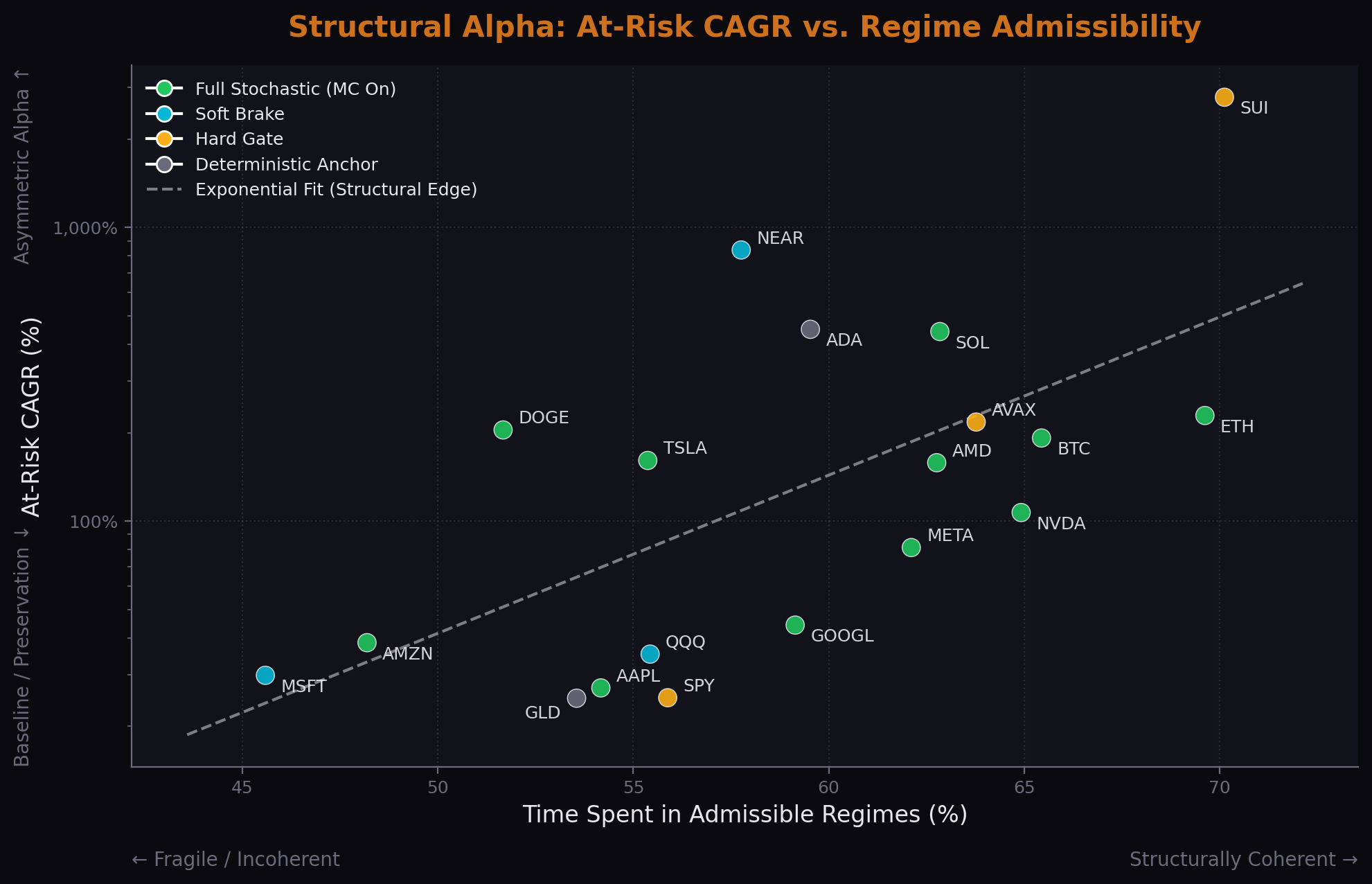
At-Risk CAGR is directly and exponentially linked to the time an asset spends in structurally admissible conditions. Assets fully managed by stochastic intelligence (Full Stochastic) consistently outperform those controlled by deterministic gates.
Admissibility Edge
The framework generates alpha by strictly limiting exposure to structurally incoherent market conditions. The exponential trendline shows that regime coherence, rather than the underlying asset class, is the main driver of exceptional strategy returns.
Disposition Variance
The variance around the baseline is not random noise. It is fully explained by the framework's Hybrid Confirmer Layer and Monte Carlo filtering, as shown by the clear separation of the disposition tiers (Full Stochastic vs. Hard Gate).
Performance Attribution
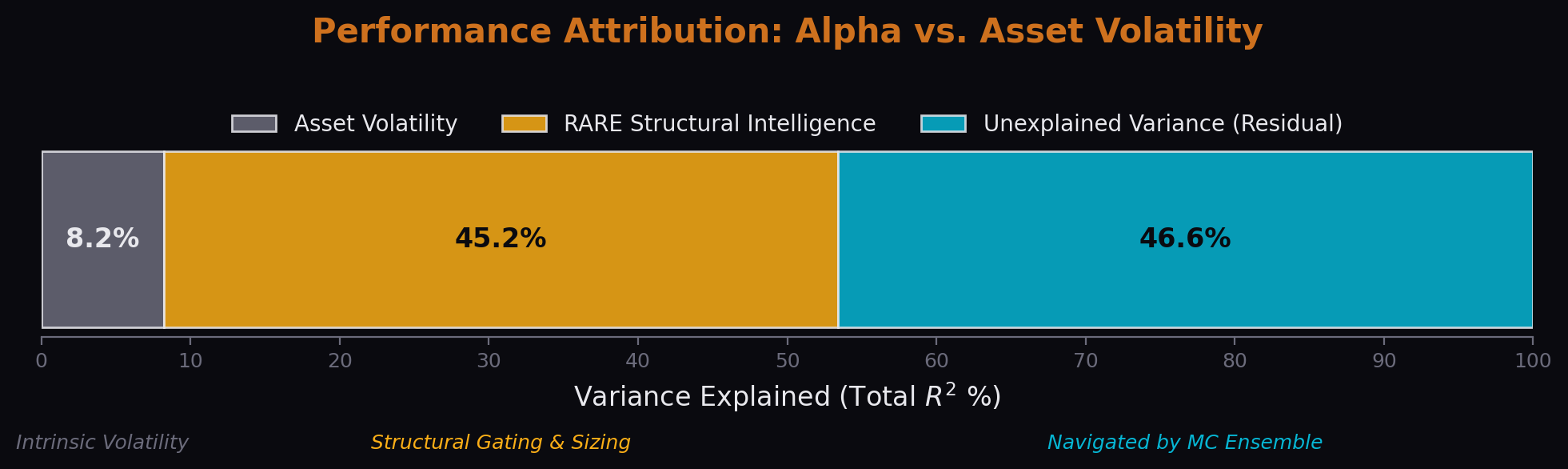
Demonstrating that the framework's returns are generated by structural intelligence, not merely by the inherent volatility of the underlying asset.
Alpha vs Asset Volatility
Variance partitioning shows that baseline asset volatility accounts for less than 9% of the strategy's total explained variance. Over 45% of the performance variance is directly attributable to the RARE framework's structural gating and sizing logic.
Unexplained Residual
The unexplained residual (~46%) represents the remaining variance in performance that cannot be captured deterministically. The Monte Carlo ensemble layer is specifically designed to navigate this residual probability space.
Forward Walk Validation
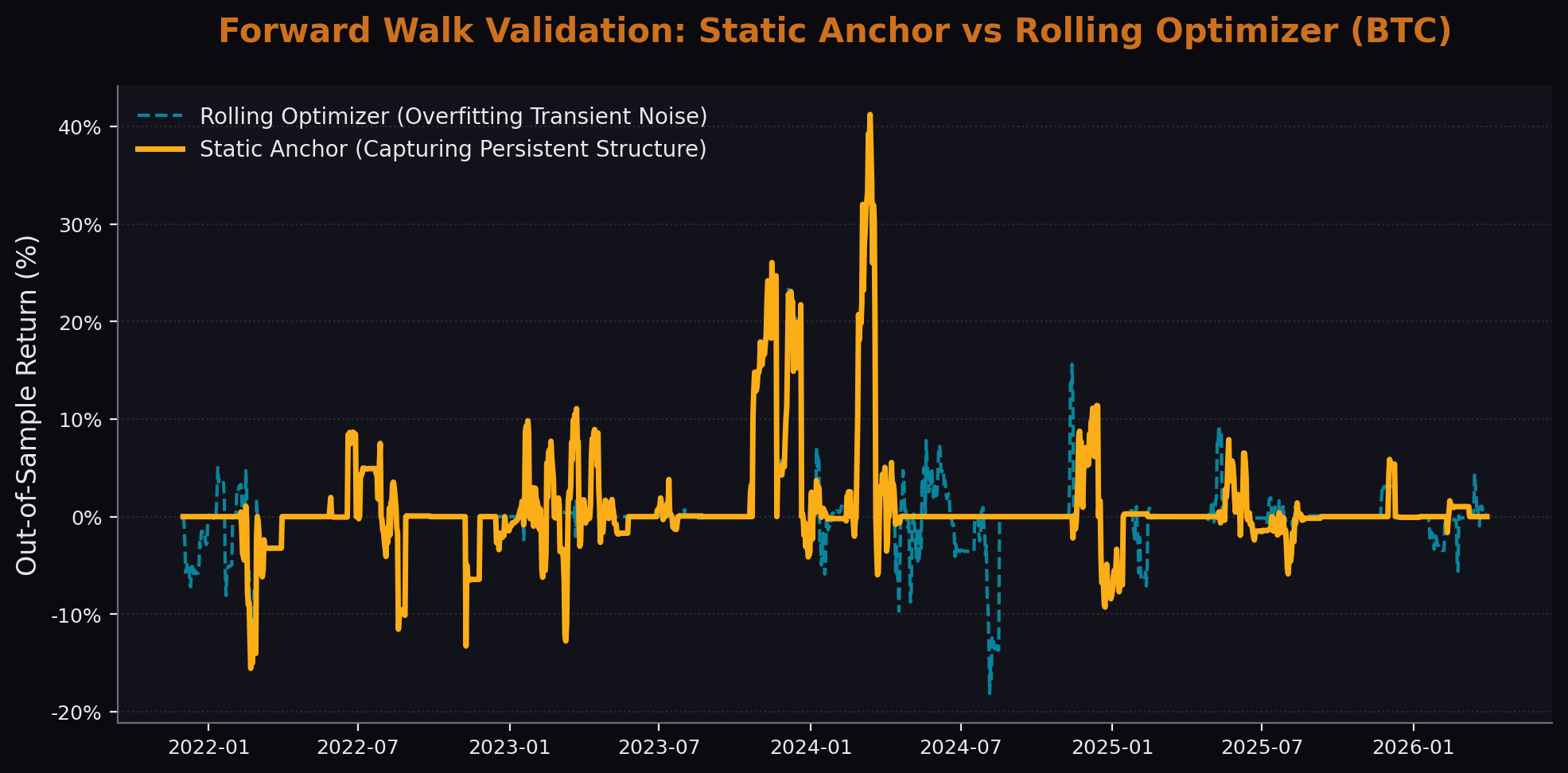
A critical test of framework robustness: do statically calibrated parameters outperform strategies that use rolling re-optimization?
Static Anchor Superiority
Production thresholds calibrated once on historical data and locked forward consistently outperform strategies that use rolling re-optimization. This shows that the structural signals being captured are persistent properties of market microstructure, not temporary statistical artifacts.
Regime Persistence Memory
Structural regimes exhibit memory lasting weeks, not just days — confirmed across all 27 assets in the structural universe. This persistence is the foundation that makes static calibration viable and rolling refit unnecessary.
Structural Decorrelation
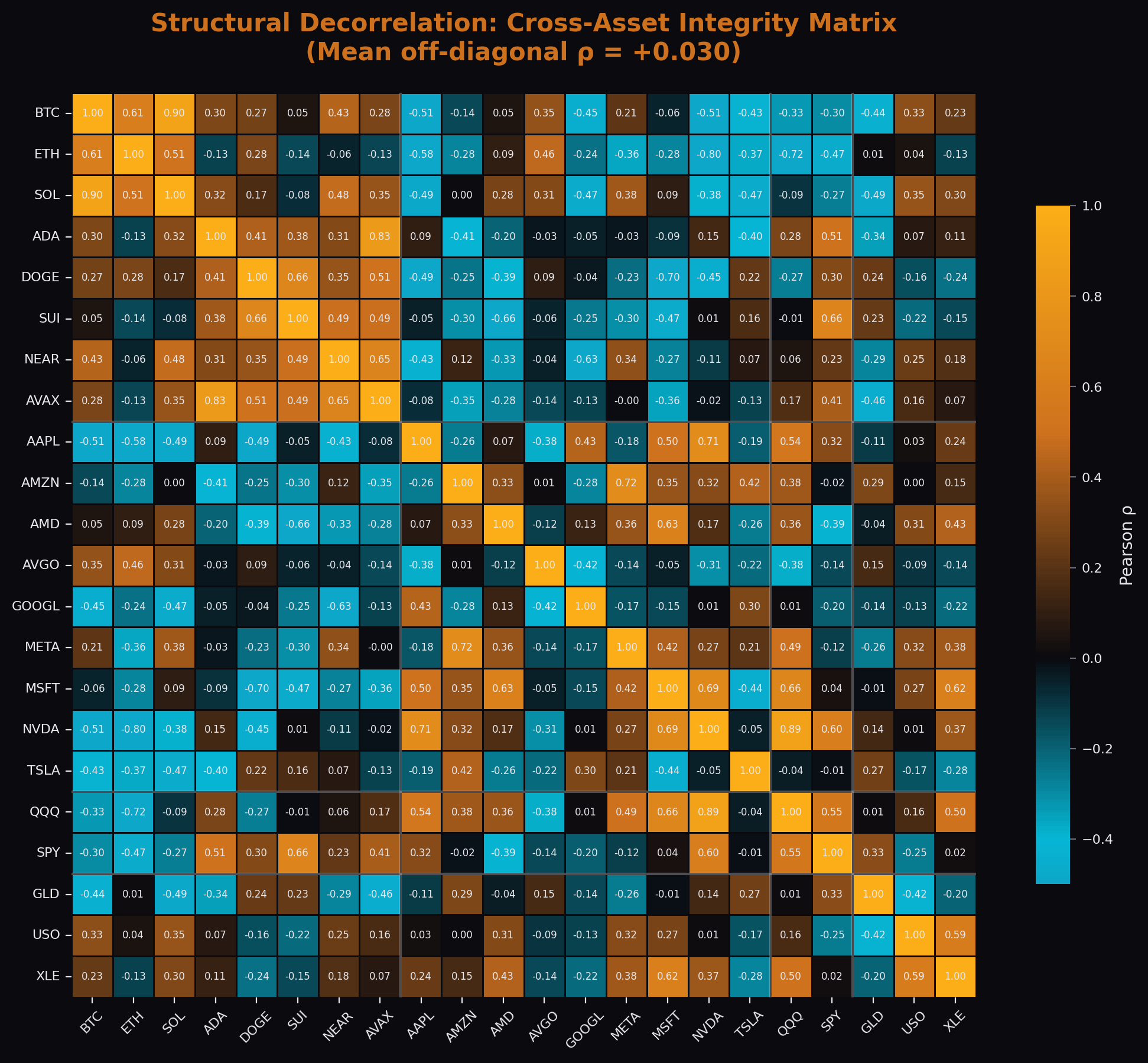
Demonstrating that structural integrity is not just another measure of volatility — and that cross-asset diversification operates in integrity space, not price space.
Integrity-Space Correlation
Cross-asset correlation measured in structural integrity space (C_t scores) rather than return space. The mean off-diagonal correlation is +0.031 — near zero — confirming that structural regimes evolve independently across assets.
Volatility Independence
An asset's structural health and its price volatility share less than 2.5% of their variation. Composite Integrity captures fundamentally different information from standard risk measures like VIX, ATR, or realized volatility.
Continuous Structural Refinement
The validation process established our core operating infrastructure. Intensive testing cycles led to the development of specialized tools, ensuring the system's mechanics are based on verifiable execution.
Rigorous validation cycles led to the development of specialized infrastructure, including identity proofs, parallel sweep engines, and deterministic replay capabilities.
Historical retracements during early validation phases directly influenced the architectural constraints, making the entire framework modular and auditable.
The discipline of mathematically re-verifying from corrected foundations ensures that every execution mechanism is built on proven, deterministic principles.
The result is a system refined through stress-testing and institutional rigor, prioritizing demonstrated operational mechanisms over theoretical correctness.
RARE Framework
The conceptual foundation includes Structural Admissibility, Three Pillars of Integrity, Composite Integrity, Monte Carlo Simulation, Dynamic Braking, and Asymmetric Consensus.
Explore FrameworkRARE Foundation
Structural admissibility, Monte Carlo ensembles, and regime persistence are covered in peer-ready published research.
Read PapersRARE Validation
Proving the infrastructure works and the results are correct involves structural foundation, tools, Monte Carlo simulation, outcome validation, and portfolio validation.
Review Validation