RARE Framework
Risk-Aware Routing Engine — the foundational concept for assessing if market structures support capital deployment.
Structural Admissibility
The core thesis: Markets alternate between states that are structurally admissible and inadmissible. This distinction is measurable, persistent, and actionable. The framework evaluates whether the current structural environment supports disciplined capital deployment, without predicting price movements.
Three Pillars of Integrity
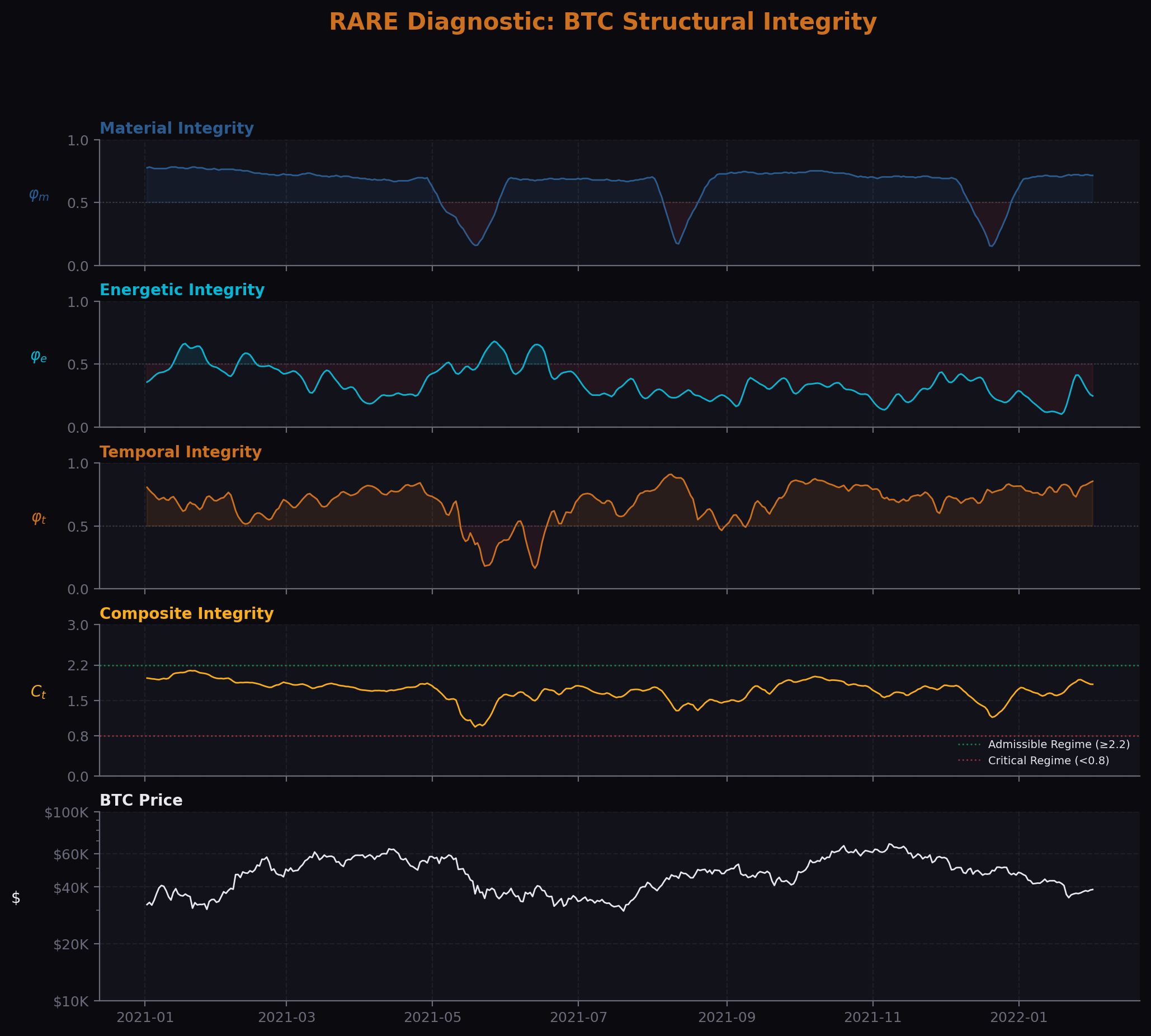
Admissibility is assessed across three independent structural dimensions. Each pillar evaluates a different aspect of market health, and all three must contribute to a passing score. The diagnostic chart illustrates this during the volatile 2021–2022 Bitcoin cycle, showing how the pillars work together to maintain exposure during the Q1 euphoric run, execute a structural hard block during the May crash, and effectively prevent capital deployment before the multi-year crypto winter. Note the sharp transitions in Material Integrity, demonstrating the engine's ability to detect structural breakdowns instantly, unlike traditional moving averages.
Material (φ_m)
Price structure integrity — evaluating trend coherence, support/resistance architecture, and the quality of the price signal itself.
Energetic (φ_e)
Volatility regime stability — measuring whether the current volatility environment is structured or chaotic, and whether regime transitions are orderly.
Temporal (φ_t)
Cycle and momentum alignment — assessing whether the asset's temporal dynamics support forward deployment or signal structural exhaustion.
Composite Integrity
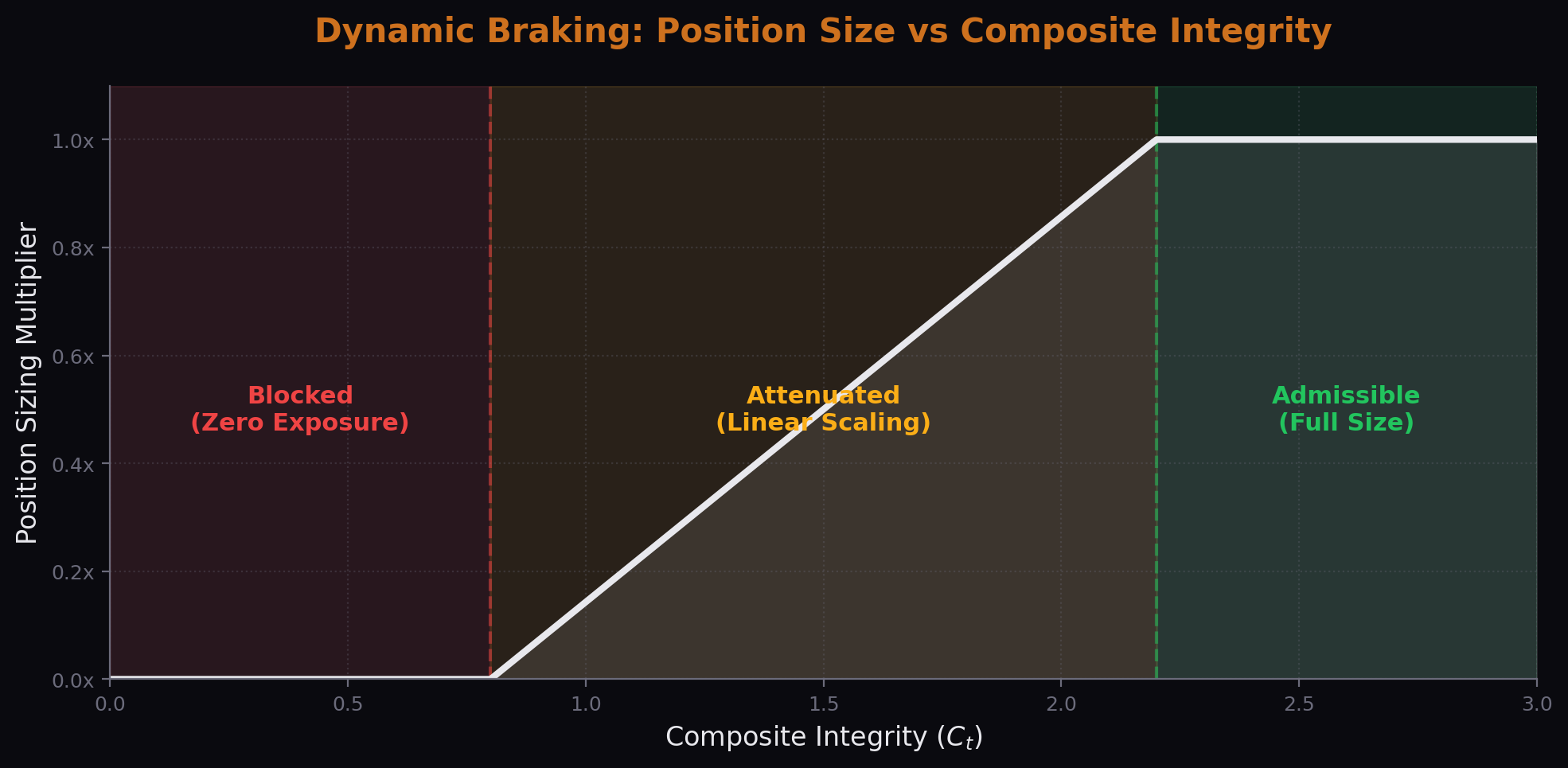
The three pillars combine into Composite Integrity (C_t) — a single score from 0 to 3. An admissibility threshold (≥ 2.2) indicates when market structure is suitable for full capital deployment. Below the critical threshold (< 0.8), all new positions are blocked regardless of signal strength.
Monte Carlo Simulation
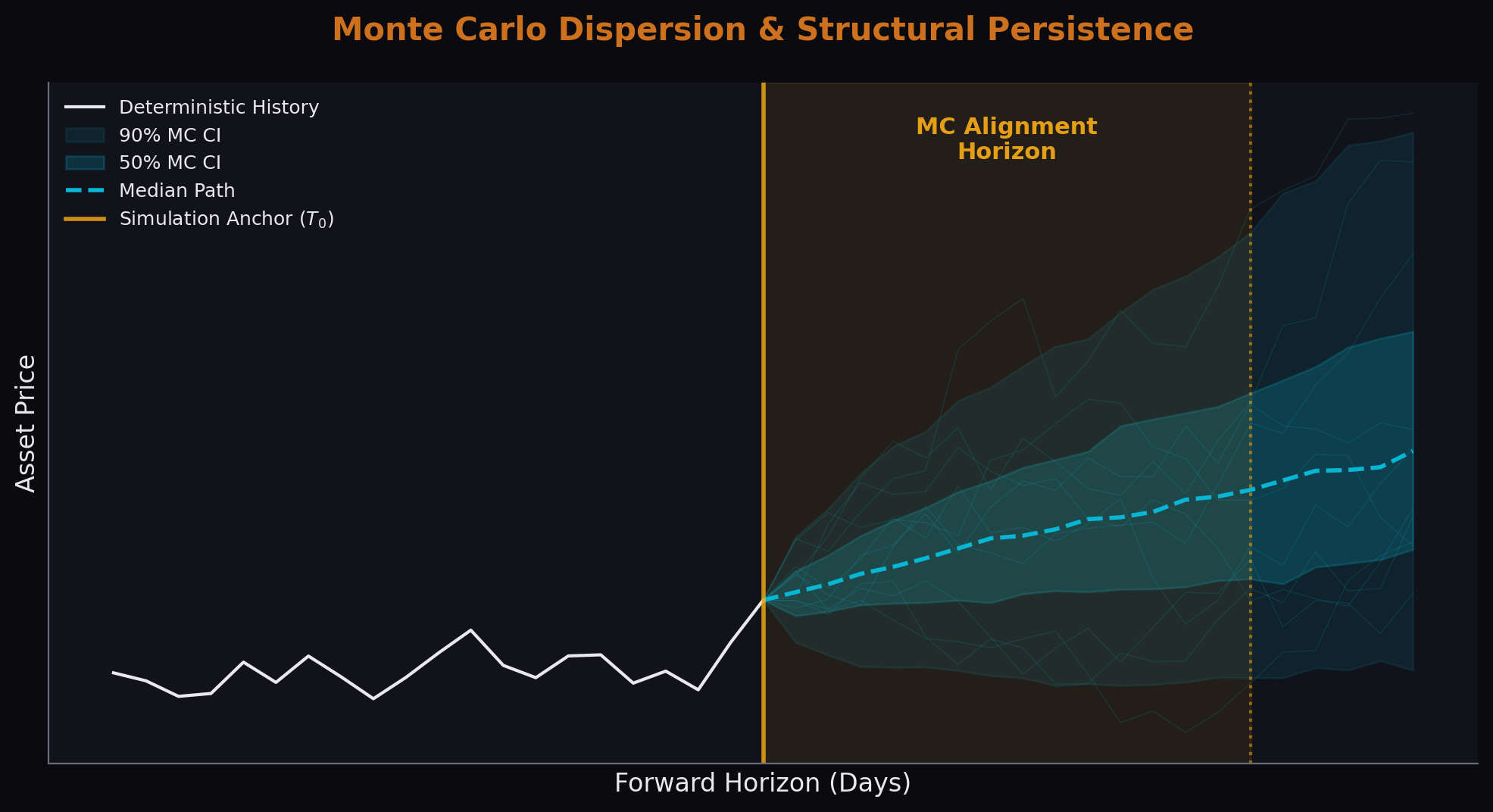
Forward-looking stochastic ensembles generate price dispersion insights based on each asset's current structural state. Seeded, reproducible simulation paths provide estimates of bias, sigma, and expected value over a 15-day structural alignment horizon, grounding forward conviction in statistical physics rather than narrative prediction.
Per-Asset Disposition
Not every asset responds the same way to stochastic alignment. The production universe is divided into four disposition tiers based on empirical validation of Monte Carlo signal contribution.
Full Stochastic (MC On Optimized)
Assets where Monte Carlo signal override, deterministic pathing, and per-asset z-score thresholds are all active. Monte Carlo provides full consensus alignment over timing and conviction. Most of the production universe operates in this mode.
Soft Brake
Assets where Monte Carlo evaluates forward pathing but does not enforce a hard signal veto. Stochastic intelligence informs sizing through distance modulation, but the deterministic pipeline retains final timing control.
Hard Gate
Assets where Monte Carlo stochastic routing is completely bypassed. The decision engine operates solely on deterministic structural physics — Technique J and z-score braking still apply through the deterministic pipeline.
Deterministic Anchor
Macro-level assets used for cross-asset regime context. These operate without Monte Carlo alignment or distance sizing, providing stable reference signals for the broader portfolio orchestration layer.
Dynamic Braking
Capital deployment is adjusted through multi-tiered gating. Hard thresholds completely block execution when structural integrity fails, protecting capital from being deployed in hostile environments. Soft thresholds reduce position sizing as conditions worsen, scaling exposure according to structural confidence rather than using binary on/off switches.
Asymmetric Agreement
The final synthesis layer requires independent stochastic simulations to reach agreement with structural integrity measurements before capital is deployed. Each simulation operates independently, and agreement across ensembles is necessary for confidence. No single layer can override the ensemble's decision.
RARE Framework
The conceptual foundation includes Structural Admissibility, Three Pillars of Integrity, Composite Integrity, Monte Carlo Simulation, Dynamic Braking, and Asymmetric Consensus.
Explore FrameworkRARE Foundation
Structural admissibility, Monte Carlo ensembles, and regime persistence are covered in peer-ready published research.
Read PapersRARE Validation
Proving the infrastructure works and the results are correct involves structural foundation, tools, Monte Carlo simulation, outcome validation, and portfolio validation.
Review Validation