Research Foundation
Peer-ready research documents on structural admissibility, evaluation frameworks, and simulation methodology.
WP1: Structural Admissibility of Asset Price Trajectories
Most trading systems attempt to predict future price movements. This paper adopts a fundamentally different approach: instead of forecasting, it defines the mathematical conditions under which a price trajectory is structurally sound enough for capital deployment. Drawing from physics and differential geometry, we analyze each asset's price path through three independent structural dimensions — Material (geometric continuity), Energetic (coordinated participation energy), and Temporal (regime stability) — to produce a single, real-time admissibility score.
HIGH ENTROPY NOISE
Stochastic market baseline (Entropy > Critical Threshold). Millions of individual trades and news events colliding to create unstructured, random-walk price components without a structural anchor.
MATERIAL CONSTRAINT
Filters out physical market incoherence strictly through the price geometry. Verifies the trajectory possesses sufficient point-density and continuity to behave as a cohesive structural medium, filtering out sparse, gap-ridden, or illiquid paths.
DIRECTIONAL AMPLIFICATION
Evaluates the orthogonal, dissipative energetic component of the system (inclusive of, but not limited to, directional volatility). Identifies regimes where signal translation physically cascades into coordinated directional amplification.
ADMISSIBLE TRAJECTORY
Tests structural persistence orthogonally across a specific time horizon. Evaluates whether the coordinated energetic state exhibits statistical memory, identifying an admissible trajectory whose structural integrity has not decayed back into baseline noise.
Material, Energetic, and Temporal are the three primary branches of integrity — a gating channel for the integrity field. Only a trajectory that passes all three branches persists as an admissible path.
The diagram above shows how a raw, noisy price path is filtered through three orthogonal integrity dimensions. Only trajectories that meet all three constraints — smooth geometry, coordinated energy, and stable regime — are classified as admissible for capital deployment.
- Replaces the prediction paradigm with constraint-based trajectory evaluation — we do not predict direction; we measure structural fitness.
- Introduces a composite admissibility score derived from three independent, physics-grounded integrity dimensions.
- Mathematically demonstrates that disciplined abstention (refraining from trading when structure breaks down) is not only prudent but is the optimal strategy under structural uncertainty.
WP2: Empirical Validation of Structural Admissibility
The theoretical framework asserts that structural admissibility is a real, measurable property, not a statistical artifact. This paper tests that assertion across 27 assets, including crypto, equities, indices, commodities, and volatility products. For each asset, the observed admissibility behavior is compared against 1,000 randomized surrogate processes that maintain the underlying return distributions, isolating real structural patterns from random noise. The central finding: structural alignment clusters in time far more than chance would predict, and this clustering is independent of volatility, indicating it reflects something genuinely different from standard risk measures.
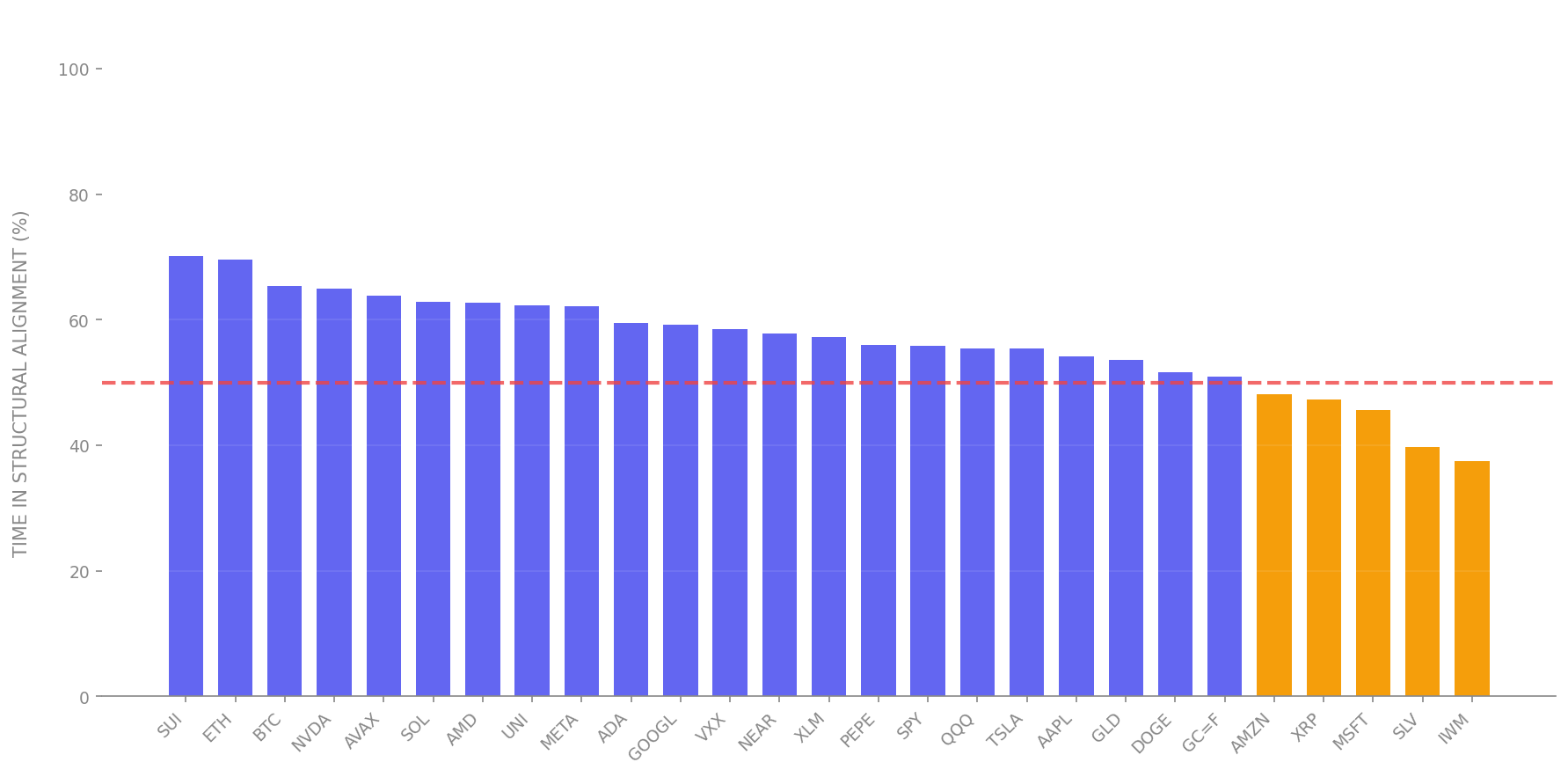
The chart ranks all 27 assets by the percentage of their history spent in structural alignment (admissibility score ≥ 1.50). Assets in indigo spend more than half their time structurally aligned, indicating the framework identifies stable, deployable conditions most of the time. Assets in amber fall below 50%, indicating more challenging structural environments where stepping aside provides measurable protection.
- Structural alignment is not random — it clusters in time and is clearly distinguishable from noise across all 27 assets tested.
- The framework works across every asset class: crypto, equities, indices, and commodities all show the same structural behavior, varying only in intensity.
- Structure and volatility are independent — the admissibility signal captures information about how markets organize themselves that traditional risk measures simply cannot see.
WP3: Threshold Sensitivity & Persistence Universality
The previous study demonstrated that structural persistence is real. This paper explores whether it is fragile or robust under different settings. We test the framework across its full range of sensitivity settings and measure how long structural regimes last at multiple time horizons. The results are clear — every asset in the universe shows significant structural memory lasting weeks, not just days. The settings do not matter: the same patterns appear whether we use the strongest possible configuration or a completely neutral one chosen before the study began.
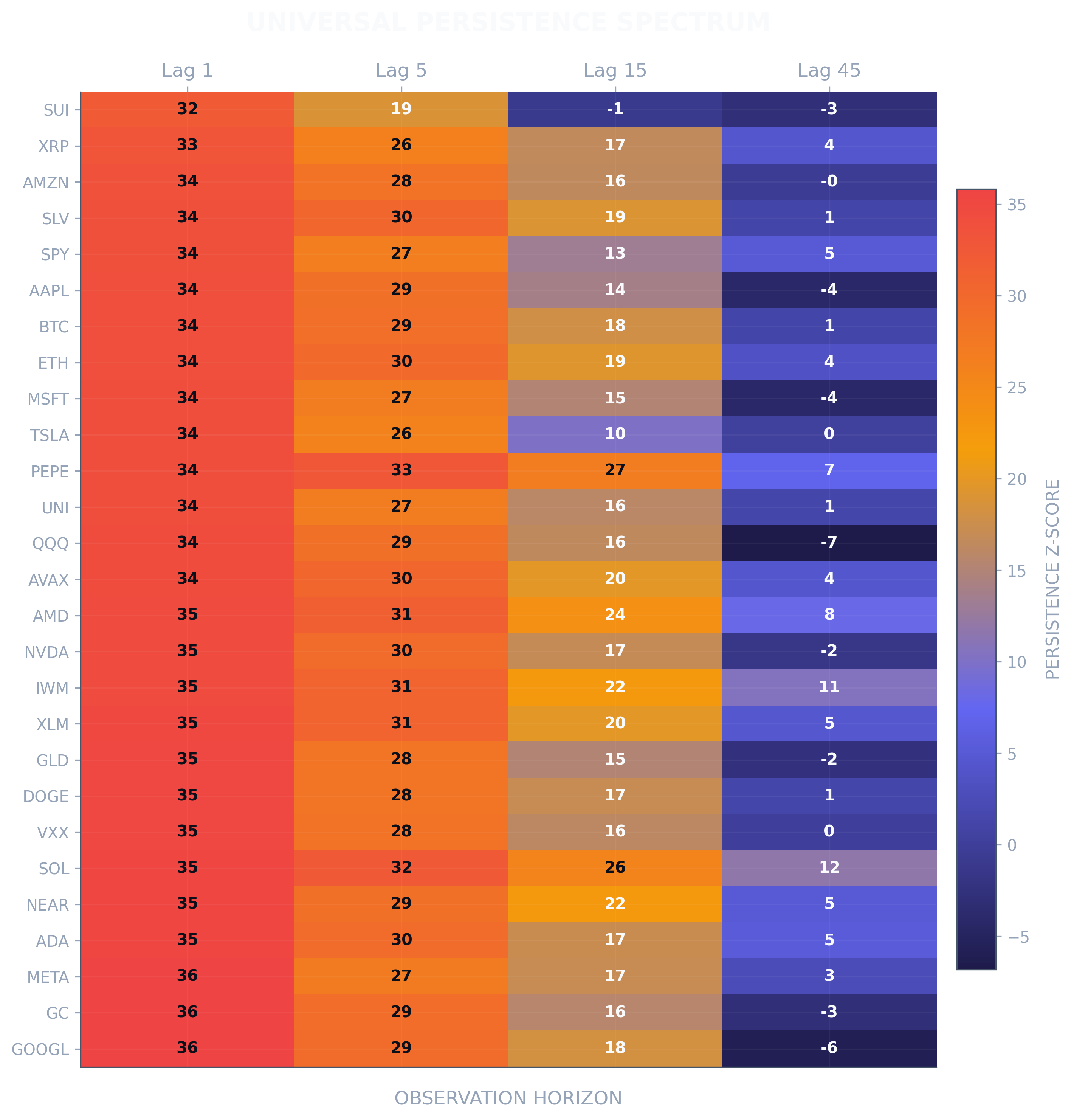
The heatmap shows how strongly structural memory persists for all 27 assets across four time horizons (1 day to 45 trading days). Warmer colors indicate stronger structural memory. Even at the 15-day mark (three trading weeks), most assets show persistence scores well above anything random chance could produce. The gradual cooling from left to right confirms that structural regimes fade predictably, not suddenly, allowing the system time to respond.
- Every single asset shows significant structural memory at the 15-day horizon — this is a universal property, not something that only works for certain markets.
- The results hold regardless of how the sensitivity threshold is set — the framework is not tuned to produce good results, it works inherently.
- Structure and volatility measure fundamentally different things: an asset's structural health and its price swings share less than 2.5% of their variation, confirming the framework captures something traditional tools miss entirely.
RARE Framework
The conceptual foundation includes Structural Admissibility, Three Pillars of Integrity, Composite Integrity, Monte Carlo Simulation, Dynamic Braking, and Asymmetric Consensus.
Explore FrameworkRARE Foundation
Structural admissibility, Monte Carlo ensembles, and regime persistence are covered in peer-ready published research.
Read PapersRARE Validation
Proving the infrastructure works and the results are correct involves structural foundation, tools, Monte Carlo simulation, outcome validation, and portfolio validation.
Review Validation